
Britain next Prime Minister
Keir Starmer's term is ending, but nothing will change.
For those who don’t follow the minutiae of British politics, here is a brief overview.
Labour Prime Minister Keir Starmer has become the most unpopular British national leader since records began. This was confirmed not just by polling, but by the local election results of April 2026, in which Labour lost 1,500 seats out of 2,200 contested seats.
However, the Labour Party’s leadership is bereft of serious contenders for the top job. Therefore, rather than simply replace the sitting Prime Minister with another Member of Parliament (the PM must be in the House of Commons or the House of Lords), the party vacated a safe parliamentary seat and let the Mayor of Manchester, Andrew Burnham, run. He won spectacularly on the promise of replacing Starmer and reforming British politics.
Starmer is almost certain to resign or be forced out, and to be replaced by Burnham.
The problem for Labour, however, is structural. It is the party of welfare and immigration, not of economic growth. Its current leadership and cabinet are so bereft of talent that it could not provide an alternative candidate, and had to bring Burnham in.
Who is Burnham?
Burnham, a career politician with no private sector experience, has been a fixture of the Labour Party for over two decades. He served under Tony Blair, Gordon Brown, and Jeremy Corbyn. In these roles, he regularly advocated for more state spending on social care. His economic model of “Manchesterism” relies heavily on state spending. He ran for the Labour leadership before and lost. There are no major distinctions between him, Keir Starmer, or Tony Blair. Except that, unlike during the Tony Blair years, interest rates in 2026 are much higher, and public tolerance for immigration and demographic change is much lower.
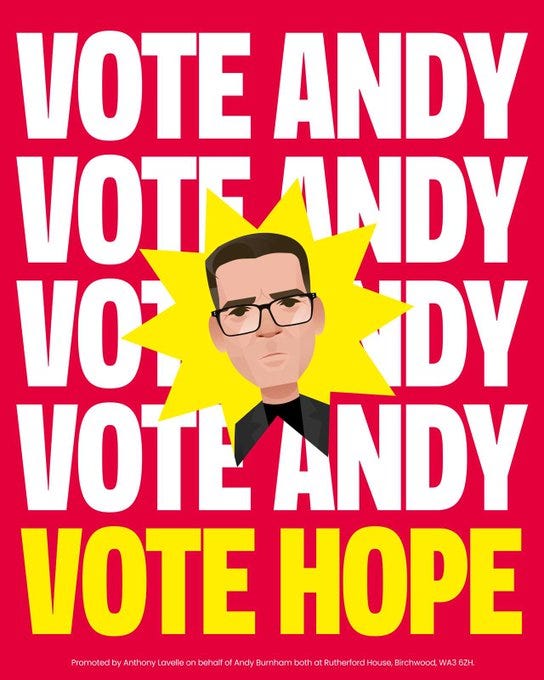
Like most Labour politicians, Burnham supports Net Zero zealotry, immigration extremism, regulation, and high levels of government social spending. However, when under pressure, Burnham has shown some political flexibility. He no longer advocates for Britain to return to the EU. He supports Home Secretary Shabana modest Mahmood’s restrictions on immigration. And he promises he will stick to Chancellor Rachel Reeves’ budgetary restrictions.
What can he achieve?
Oddly enough, quite a lot.
Labour current backbenchers are notoriously left wing and the front bench is hollow. However, Labour is currently so weakened that it staked its entire existence, and its performance in the next general election, on Burnham. Labour cannot afford to replace more than one Prime Minister over the life of a single Parliament - it knows it would be crushed by voters if it showed the same kind of chaos as the Conservatives did after the 2019 election, when they went through three Prime Ministers. Therefore, despite the backbenchers being extremists, Burnham is in a position to whip them into compliance.
Therefore, despite his rhetoric about not wanting to be in hoc to the bond markets, Burnham is almost certain to maintain the current economic orthodoxy. He will be as beholden to the diktats of the Treasury as Brown, Cameron, May, or Starmer.
