
Burnham's inevitable collapse
Britain's situation is set to worsen dramatically
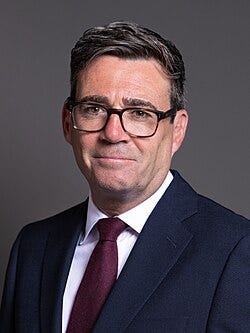
Andy Burnham took office as Britain’s Prime Minister on 20 July 2026, and appointed his cabinet.
Observations
Before delving into some individual appointments and what they mean, it is worth making four points:
There is clearly a conflict in the Labour Party between northerners and southerners. Starmer represented the southern elite wing of the party - the lawyers, the civil servants, the upper echelon NGO workers, the quangocracy. They are at odds with the north over the distribution of resources: the northerners believe that the south is too rich, and that higher taxes should result in more welfare for the north, given how badly done by the north has been as a result of de-industrialisation.
Burnham more or less purged the Starmer loyalists from the cabinet, and would not appoint someone like Al Cairns as defence minister, probably because of Cairns’ own rather obvious prime ministerial ambitions. The exclusion of the south, and of competent potential rivals, is going to escalate the north-south conflict within Labour. Already, Starmer loyalist and former Cabinet Minister Darren Jones, who is seen as relatively competent, is criticising Burnham for promising to cut VAT on electricity bills and fund that by ending DigitalID: Jones points out that DigitalID was not funded, and that, pointedly, that Burnham would have to fund the promises that he is making. It is early for this kind of infighting to be made public, and it is a sign of things to come.
No one in the Burnham cabinet has any relevant private sector experience. Burnham himself worked for a publishing company for three years. His First Secretary of State worked in Aviva for three years. The Home Secretary worked as barrister for three years. That is all. The rest have had their careers focussed exclusively on politics, local councils, charity, and so on.
Burnham’s worst quality, compared to Starmer, is that he wants to be popular, and wants to gain popularity by spending money thoughtlessly. Starmer, to his credit, cared not a whit about being popular. He was cautious and mechanical in his speech, whereas Burnham has a tendency to make promises with no concern as to whether he can keep them.
The cabinet
Having made these points, we will examine some of Burnham’s top appointments and then the commercial implications:
The new Chancellor of the Exchequer, John Healey, is committed to raising defence spending. While this is necessary, there simply is no money, given the rest of the cabinet’s support for more tax and spend policies. Healy is supposed to be there to comfort the market, but he is only able to do so because the alternative was “Red” Ed Miliband.
The appointment of the new Defence Secretary, Wes Streeting, is only explainable by internal party politicking: Streeting has no qualifications for the role. Al Cairns or Dan Jarvis would have been much more credible candidates. However, Streeting had agreed not to challenge Burnham in a leadership contest following Starmer’s resignation, leading to his elevation.
The new First Secretary of State, Cabinet Office Minister, and Chancellor for the Duchy of Lancaster, Louise Haigh, was convicted of fraud for getting her then employer to upgrade her Blackberry to a new iPhone 5 by falsely claiming she was mugged. This sort of petty corruption may suggest an appetite for much bigger corruption. Furthermore, she is on record as a massive supporter of more tax and spend policies. She is a supporter of larger tax rises - including wealth taxes. In her view, that would stabilise government revenues and permit more spending.
