
Failed talks, successful attacks, and a fragile economy
The talks between Iran and the USA are unlikely to succeed, at least until the financial system is on the brink.
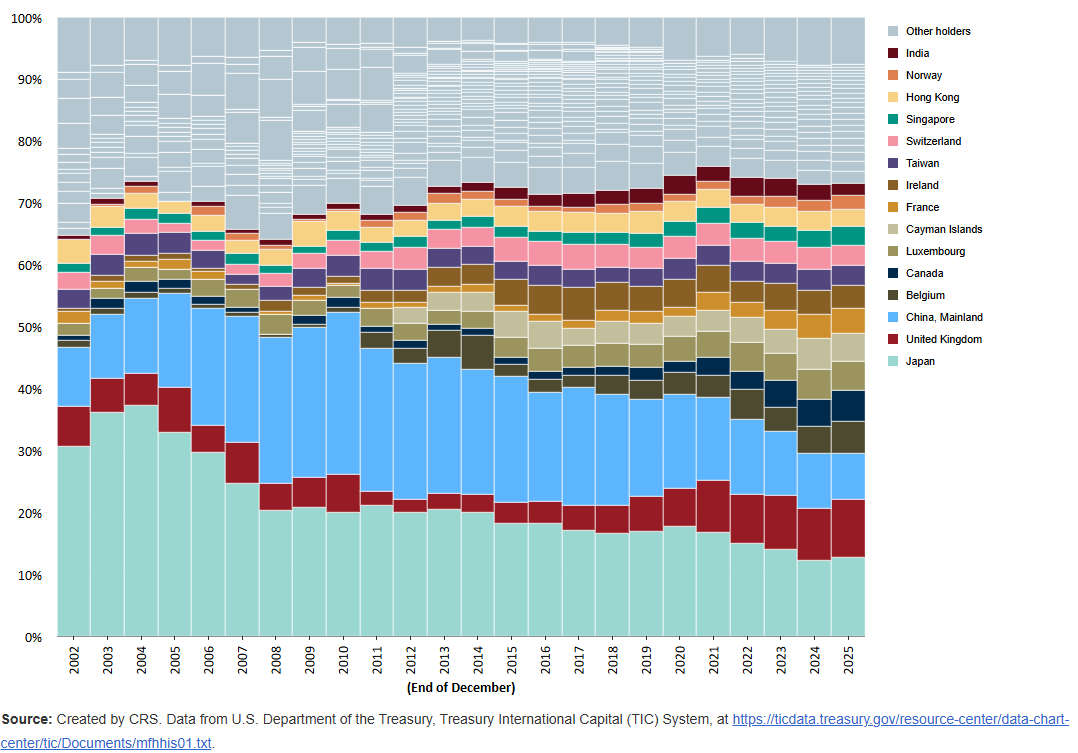
The American Treasury is intervening heavily to help safeguard the Japanese Yen. The Americans are concerned that a sell-off of the yen would force the Japanese to sell their holdings of American treasuries to defend their currency. Japan is the world’s biggest holder of US treasuries, followed by the British, then the Chinese.
Robbing Peter to pay Paul
However, to defend the Yen, the US Treasury is selling Euro holdings - selling Treasuries would increase interest rates on American debt. The issue is that both the Yen and the Euro are facing downward pressure due to the energy shock created by the US-Iran War and the continued closure of the Strait of Hormuz. Moreover, both the Eurozone and Japan suffer from enormous debt liabilities, making them vulnerable to interest rate movements should their currencies depreciate. The Americans are therefore engaged in a delicate balancing act intended to save the financial system from the inevitable ruinous consequences of massive indebtedness.
The urgency of the situation is reflected in the request of US Treasury Secretary Scott Bessent that the Federal Reserve expand the Foreign and International Monetary Authorities (FIMA) repo facility, which permits central banks around the world to access dollars by using their Treasuries as collateral. Congress has authorised up to USD60 billion for FIMA’s use, although currently, as of 29 July, it appears that only USD6 billion is in use. With Bessent deliberately leaking to media that buying USD5-10 bn in yen was on his to do list, it appears that that is just the start.
This is further confirmed by the inversion in the relationship between treasury yields and stock market performance in the USA. According to The Kobeissi Letter, higher yields and stronger stock market performance typically typically went hand in hand, suggesting confidence in a growing economy. Now, the correlation is in the most negative territory since 1999 - before the 2000 crash. This, according to Kobeissi, suggests that investors are losing confidence in the American economy, to a degree that is higher than the loss of confidence in 2000, 2008, or 2022.
Tightrope Act
Therefore, Bessent and the Federal Reserve need to tread cautiously. On the one hand, they need to comfort markets, and appease Trump, who views the stock market’s performance as a key metric of his success. On the other, backing the yen indefinitely is not an option, given the structural weaknesses driving its decline: namely, the increase in energy import costs, which place a burden on Japan’s current account, and the uncertainty around American trade policy, which is critical for Japan. Critically, Japan does not have the option of raising interest rates: its debt burden of 250% of GDP is so large that higher interest rates would break the entire system. Furthermore, Japanese corporates are so addicted to debt that many would go bankrupt in the event of higher interest rates. Currency manipulation is the only policy tool, but it cannot survive the structural challenges imposed by geopolitics. This would be especially true if the Chinese played their Taiwan card. Last, the interest rate differential between the USA and Japan has narrowed significantly, as the Americans also enter a phase where they need low interest rates. Meaning that they cannot afford a yen crisis that triggers a Japanese sell off of US Treasuries, meaning that the Americans must intervene more. This is naturally tempting to hedge funds - or state actors - who may choose to challenge the resolve of the USA and Japan, contrary to the market dictum “don’t bet against the Fed”. The one source of confidence is that China equally does not want a global economic recession - yet.
The Energy Context
Trump’s continuous declarations of an imminent deal with Iran must be read within the above financial context. Add to that the following realities:
