
Iran Goes All Out
With renewed strikes on Oman and Qatar, it seems that the war is back on in full, but the Americans face enormous constraints.
Commercial topics: airspace closures, Hormuz blockade, Bab al-Mandab, damage to regional infrastructure.
Oman announced on 12 July that Iran had struck assets in its Musandam Governorate with UAVs. Musandam sits across from Iranian territory in the Strait of Hormuz. It is the most likely location for American ground-based surveillance assets intended to help police traffic through the Strait and monitor Iranian attacks on ships. Attacking Musandam, which is sparsely populated and incredibly vulnerable to drone, missile, and small boat attacks, is a signal from Iran that Omani control over that territory is not necessarily permanent. Oman only acquired this previously ungoverned territory due to British backing in the 1970s, and its residents travel to Iranian islands and cities on the other side of the strait regularly: smuggling and trade with Iran are the main economic activities there.
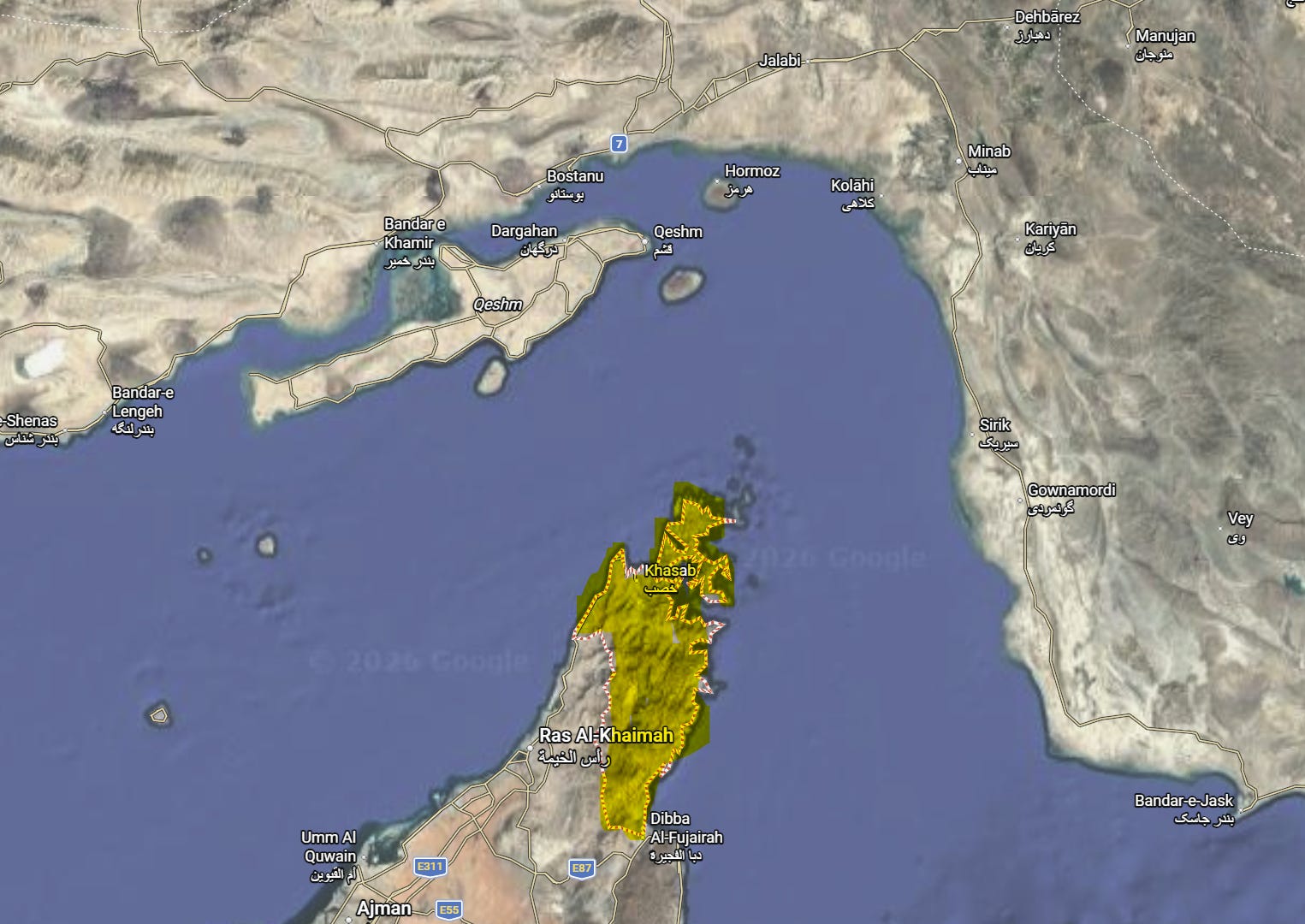
The attack on Oman followed negotiations on 11 July between Iran and Oman on future management of the Strait of Hormuz. The Omanis proposed to run one free of charge corridor in the south while the Iranians run another in the north, for which they would collect fees. This was obviously unacceptable to the Iranians, as they insist that only Iran run the Strait, niceties of international law be damned. The Iranians intend to compel Oman to collect fees for passage through Hormuz and to split those fees with Iran.
To make its point clear, on 11 July, Iran targeted the engine room of a Cyprus-flagged container ship in the southern (Omani) corridor of the Strait with a cruise missile, rather than a drone. First, a cruise missile is harder to intercept. Second, it is far more likely to sink a ship. News reports state that the crew has evacuated the ship using lifeboats, meaning that the ship is not likely to be recovered.
Iran also conducted attacks on Bahrain, Jordan, Kuwait, Qatar, and the UAE. There were no reports of attacks on Saudi Arabia. This may be because of Pakistani pressure, or simply the result of the Saudis refusing to announce that they were hit. The USA announced wide retaliatory strikes on Iran.
As we had said, the Iranians seem to believe that they have the upper hand, due to historically low oil reserves and the West’s fear of a global financial crisis that would follow any re-closure of Hormuz. Iran’s position is strengthened by the depletion of American and Israeli missile interceptors.
Meanwhile, the Israelis are telling the Americans that Iran intends to kill US President Donald Trump. The Americans are claiming that this is not serious, while Trump himself is posting that he has ordered the destruction of Iran in case the Iranians kill him. This, obviously, creates rather perverse incentives. However, the importance of this is that the Israelis are placing further pressure on the USA to escalate against Iran, at a time when Iran seems willing and eager to escalate.
The Iranians are likely to claim that they were adhering to the MoU of 17 June 2026, but that it was the Americans who violated Article I, which required a ceasefire in Lebanon, Article V, which the Iranians interpret as giving them management over the Strait, and Articles X and XI, which require the USA to issue waivers for Iran’s oil and derivative trades, as well as associated services, and the gradual unfreezing of Iranian assets.
Iranian Parliamentary Speaker Ghalibaf, who is leading the Iranian negotiating team, has said that the time for uneven agreements is over. Meaning that Iran is aiming for recognition of its full sovereignty over Hormuz. The attacks on Musandam reflect this.
Russia and China are almost certain to give Iran updated targeting coordinates, to weaken the USA, and as part of Russia’s response to American support for Ukraine.
Commercial Impact:
The Iranians are escalating against Oman and Qatar, as well as the regular targets Bahrain, Kuwait, and Jordan, to increase pressure on them as mediators, and pressure the states of the region into pressuring the Americans.
