
Iranian victory
The agreement is a strategic win for Iran and a disaster for Israel.
Commercial topics (behind the paywall): When does Hormuz re-open and how; Iran-Israel escalation and its impact on the deal; sanctions on Iran.
American President Donald Trump posted on 14 June that the deal with Iran was complete. An agreement is set to be signed on 19 June in Geneva.
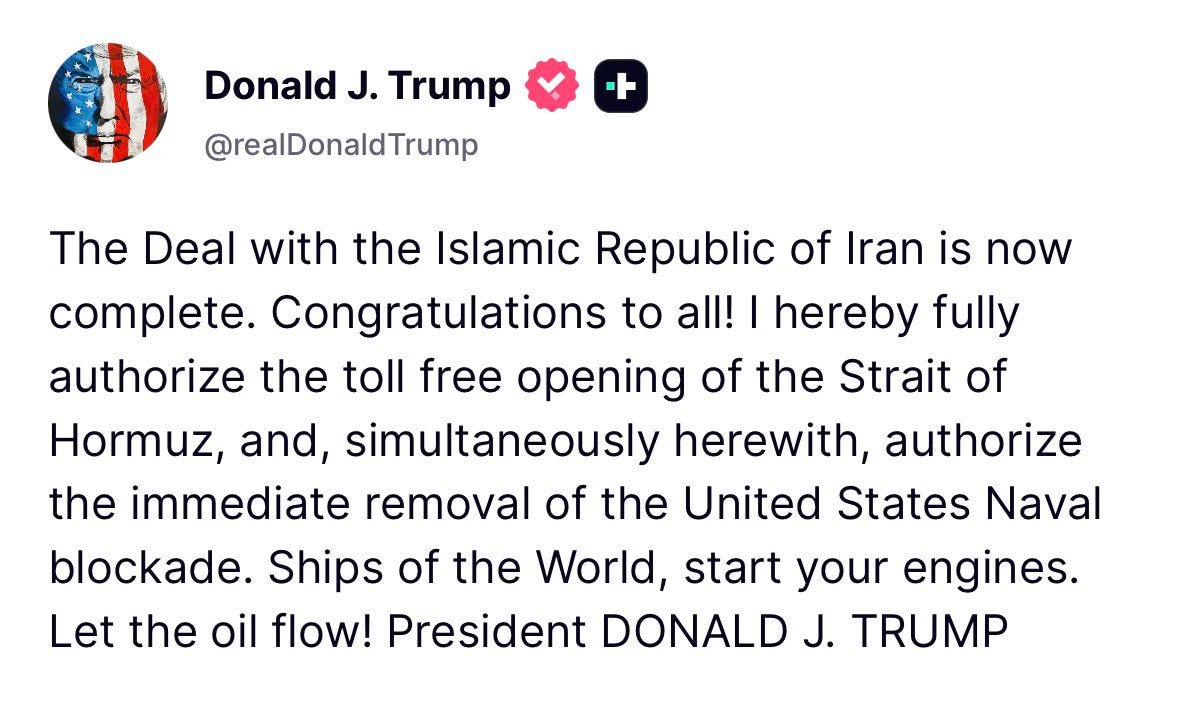
Agreement to reach an agreement
The full terms of the agreement are unconfirmed, as the two sides leak to the media their own version of the agreement. There are at least two major points of disagreement between Iranian and American leaks:
The Iranians insist that Hormuz is under their management, implying that they will be levying imperial tribute from the Gulf states.
The Americans deny that they will authorise the transfer of USD12 billion dollars to Iran before the 60 days of negotiations over the nuclear programme begin.
That said, the American and Iranian leaks suggest that the Americans have agreed that the war has to end in Lebanon, and that the talks will not address the Iranian missile programme or its support for proxies, and focus exclusively on the nuclear issue.
Meaning that the Iranians have succeeded in establishing a zone of influence that includes Lebanon in the teeth of Israeli objections, and that by implication includes Iraq and Yemen. Moreover, it means that the Iranian strategy of using the nuclear portfolio to extract regional concessions has been completely successful.

Other terms of the agreement include Iran receiving up to USD300 bn in reconstruction funds - essentially, a workaround for Iran’s demand for compensation.
Strategic disaster for Israel
The American - Iranian War has turned into a conflict between Israel and America.
On the one hand, Congress is set to pass a defence authorisation act that integrates American and Israeli R&D, procurement, and technology development, while also preparing an intelligence authorisation act that makes it all but impossible for the USA to not share intelligence with Israel, and that makes Israel the main intelligence power in the Middle East.
On the other hand, the conflict between President Donald Trump and Israel has never been greater. It is incorrect to claim that this is a conflict with Israeli Prime Minister Benjamin Netanyahu: Netanyahu acts on behalf of the entire Israeli security system.
The Israelis cannot tolerate having their freedom of action in Lebanon and the Palestinian territories limited by Iran. The implication of such a limitation is that the Iranian missile programme is sufficiently capable to deter Israeli expansionism. This setback is more evident when we recall that the Israeli media, acting as a mouthpiece for the Israeli defence establishment, was stating clearly that the problem for Israel was not the nuclear programme - there has been no evidence of weaponisation for years now according to American intelligence assessments - but the Iranian missile programme. Now that Iran has set the precedent that it can use its missiles and regional threats to constrain Israel in Lebanon, it can build and expand on it.
All of the above is on top of the Israeli and American failure to overthrow the regime or in end its support for proxies. Rather, given Iran’s defence of Hezbollah, the relationship with proxies is stronger. And with the assassination of both Supreme Leader Ali Khamenei - who as a martyr represented the hardliners and the military - and Ali Larijani - who represented the traditional court philosopher class - the regime is even more consolidated, despite the continuing traditional internal divisions.
(As an aside, the internal divisions of Iran are misunderstood. They are not partisan - principalist vs reformist vs centrist or whatever. They are caste-based. There are the soldiers, the thinkers/bureaucrats, the clerics, and the merchants. The soldiers want to fight, the thinkers and bureaucrats want to avoid war, the clerics adjudicate, and the merchants are milked while they try to buy influence and protect their assets. The system is DESIGNED to be divided, as that facilitates the ability of the Supreme Leader - who is not more than a black-turbaned Shah - to control it).
That said, perhaps the most consequential impact of the war is how it brought Israeli influence into the limelight, and turned the populist right and left against Israel.
