
Keir Starmer: Zombie Prime Minister
The old is dead, but the new has not yet been born.
Britain held elections for local councils in England and for devolved parliaments in Wales and Scotland. Labour’s losses were so bad that a leadership contest has been triggered.
Four things are evident from the results.
Labour and the Conservatives are collapsing further.
Reform UK, a centre-right civic nationalist party led by Brexit campaigner Nigel Farage, has made enormous gains.
Nationalism is rising: in Scotland and Wales, left wing nationalist parties won, while Reform itself is increasingly the party of English nationalists, even though this is not how it defines itself.
Polarisation is rising: right wing parties are being pulled further to the right, while left wing parties are being pulled further left. The Fabian gradualist progressive centre accepted by both Conservatives and Labour has collapsed.
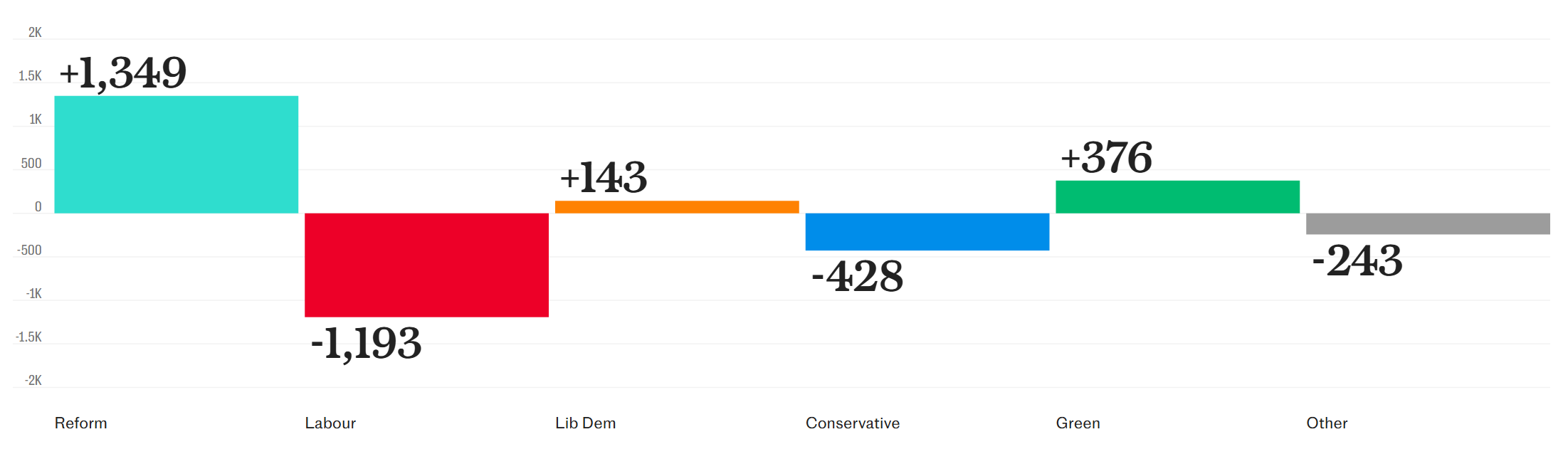
However, just like the 2024 Labour landslide victory in parliamentary elections was not a sign of support for Labour or their policies, but, rather, of hatred for the Conservatives, the 2026 resounding Reform victory is not necessarily a sign of support for Reform, Nigel Farage, or their policies. Rather, the British electorate is in revolt, as has been evident since the 2016 Brexit vote.
British politics, transformed
What we are seeing in Britain is a shift away from the establishment consensus.
The left is doubling down on support for welfare, Net Zero, and immigration, with the Green Party eating away at Labour’s voter base. What the Greens want, essentially, is more of Ed Miliband, Angela Rayner, and the Green-Red Islamic socialist alliance. In the words of former Prime Minister Tony Blair’s speechwriter Anthony Neather, they want to double down on “rub[bing] the right’s nose in diversity”. They no longer want the Fabian gradualist approach of Labour, enthusiastically endorsed by the David Cameron Conservatives, rather, they want further acceleration, with more immigration, more welfare, and more corrosive social liberalism.
The right is demanding more representation for their interests, and less government support for foreign interests, be they Jewish, Muslim, or Hindu. Immigration is the single largest electoral issue for the right, as most British regions were transformed by waves of mass immigration, legal and illegal. That is why the Conservatives, who permitted record levels of immigration, are still collapsing. The most commercially interesting part of the debate on the right, however, is on the economy: the right is no longer liberal, even economically liberal, but is rather increasingly nationalist and suspicious of big and especially of international capital.
Zombie Parliament, Zombie Cabinet
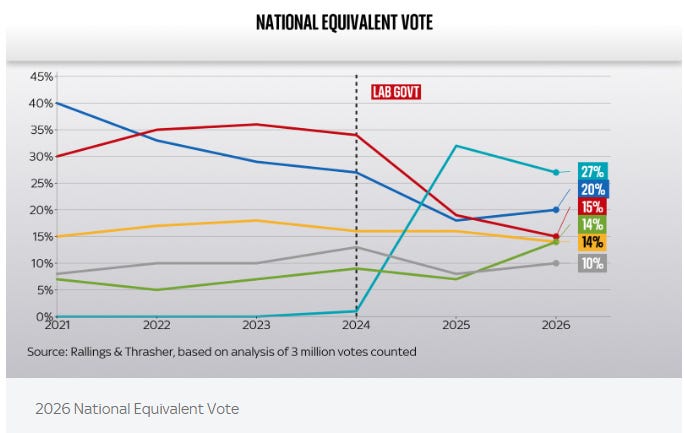
Labour lost badly in traditionally loyal Red Wall and inner city constituencies, while Conservatives lost in typically reliable Home Counties. This confirms that the vast majority of MPs currently in Parliament are almost certain to lose their seats. This is a zombie parliament - its members are, politically, walking dead.
Typically, in Britain’s first-past-the-post electoral system, parties run their leaders in safe seats, constituencies that they are assured of winning. If there are no safe seats, then party grandees may end up losing their seats, and their relevance. The established leading politicians therefore end up losing control of the party. What, if anything, emerges afterwards, is anyone’s guess. The two establishment parties could simply cease to exist, or could become vehicles for entryism by a more radical fringe.
Labour leadership’s despair
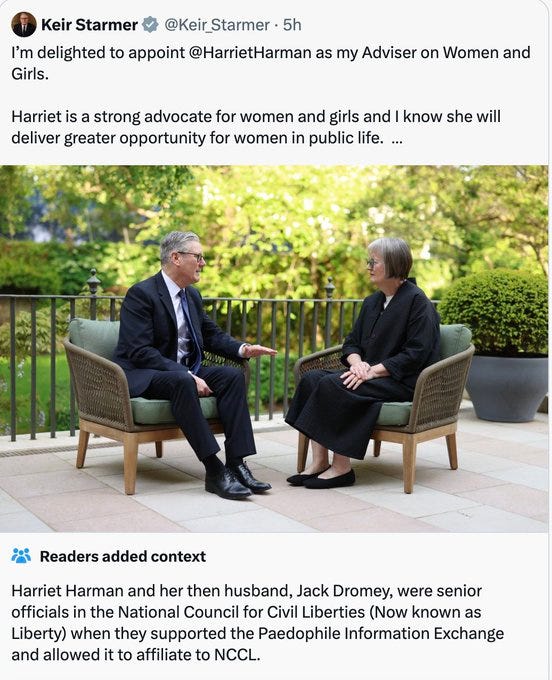
It is in this context that Sir Keir Starmer is being challenged from his left, with tens of MPs and hundreds of councillors asking that he step down, as well as some unions, who are Labour’s biggest financiers. However, instead of stepping down, Starmer is doubling down, and is bringing in older Labour party grandees, like Harriet Harman to advise him on women, and Gordon Brown to advise him on international finance. However, this is likely to backfire spectacularly. Starmer is turning to an establishment that could not win an election today and that is incredibly unpopular. Rather than address the transformation of British politics, he is recommitting to the discredited old paradigm, at a time when the base is closer to the Greens than to Tony Blair. Starmer and the Labour establishment are going to try to hold on to power until 2029, and will refuse any take over by the Labour left or an early election as they know it would end their careers.
Reform: a protest undefined
The debate on the right, and within Reform, is over the correct definition of what it is to be British: is it ancestry or a set of modern values that defines national identity. This has become more salient with the rise of the Islamic bloc vote, the discrediting of diversity, and the election of multiple individuals who are entirely foreign - arriving to Britain on visas from the Commonwealth - into council seats and the Scotting Parliament.
Reform UK, as a civic nationalist party with numerous high profile members of an immigrant Muslim and subcontinent backgrounds, is only a partial answer to what the right wing base wants. Restore Britain, a three-month old right wing party that has more members than the Conservatives and Liberal Democrats, both of which are long-established parties with a significant parliamentary presence, is challenging Reform on this territory - their answer is that it is ancestry, not modern values, that defines identity. Indeed, most of these values would have been unrecognisable to a Brit living in the 1920s, and Restore’s response would have been universally accepted for most of history. Restore only run in its founder Rupert Lowe’s constituency of Great Yarmouth. There, it thoroughly thrashed Reform, even though Lowe had entered Parliament as a Reform MP.
It is precisely because of this inconsistency that Reform remains stuck at under 30% of the vote share, despite the incredible unpopularity of both the Conservatives and Labour. At the same time, as it becomes obvious that Reform is getting closer to gaining power, more and more individuals are joining it who are simply seeking power for its own sake, without any coherent underlying beliefs. Therefore, we see Labour councillors defecting to Reform while praising immigration, even as much of the establishment media calls Reform racist, fascist, and far right. Simply, Reform is benefiting from the protest vote, but it has not defined what alternative it is providing. Indeed, its electoral strategy seems to be not to make any clear commitments before the 2029 or potentially an early election.
