Strategic Risk Brief: Israel and Lebanon
Is Hezbollah trying to trap Israel in a ground war?
Syrian forces have been mobilising around Lebanon, particularly in the direction of Homs-Hermel. This suggests that Syrian President Ahmed al-Shara’, who, rather impressively, has gone from Al Qaeda commander to World Economic Forum keynote speaker, is planning an invasion to pressure Hezbollah deep in the north, in support of Israel.
Meanwhile, Israeli targeting in Lebanon is intensifying along several fronts:
Attacks on suspected or alleged IRGC/Hezbollah officials, including in hotels well outside Shi’a areas.
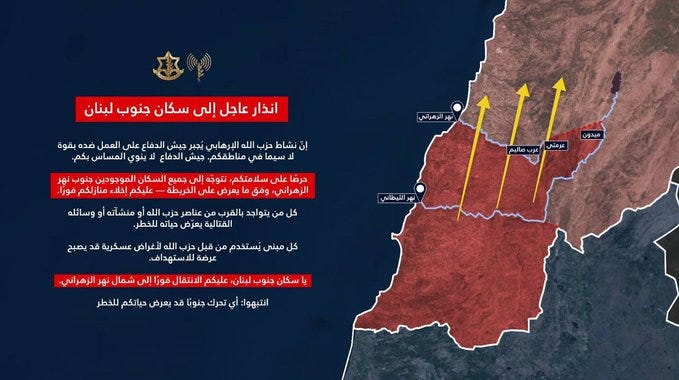
Attacks on bridges connecting the rest of Lebanon to the area south of the Litani River, intended to sever ties between the two sides before a full-scale invasion of the south.
Threats of attacks on state infrastructure with the aim of compelling the Lebanese government to disarm Hezbollah.
Lebanon has already attempted to comply. It has banned Hezbollah’s military activities and the IRGC, but, simply, the leadership of the Lebanese armed forces knows that it lacks the military capability to implement these directives. Now, Lebanon is offering to negotiate directly with Israel, with the French allegedly proposing that Lebanon recognise Israel. The Lebanese government is likely willing, but, its position is irrelevant. Hezbollah will retain a veto so long as it is armed, especially if it performs relatively well in this war. And Lebanon cannot recognise Israel without Syrian support, given the country’s dominance over the country’s land borders, and the presence of millions of Syrians in Lebanon. Not to mention the presence of Lebanese Sunnis, who view the new Syrian regime as their true leadership. Syria, for its part, cannot recognise Israel so long as Israel occupies new Syrian territories captured since the fall of Assad. It may, however, acquiesce to Lebanese normalisation, while retaining the option of using that as a wedge issue against the Lebanese government in the future.