
European governments are almost unanimously clamouring for war with Russia. These warnings emphasise that the risk of such a war will be highest by 2029, and that Russia will be the aggressor.
European leaders’ aims for these warnings are multifaceted:
First, they are seeking to force American President Donald Trump to at least include them in the negotiations over the future with Ukraine and to impose higher costs on Russia. Ideally, they want the war to continue, in order to justify
Second, they are trying to justify their confiscation of Russia’s sovereign reserves that were held in the EU.
Third, they are trying to distract their populations from the ongoing catastrophes of mass migration, demographic collapse, Net Zero, and the welfare state.
Fourth, they are trying to justify more investments in their military industries, which have been severely degraded by one-sided ‘free’ trade with China.
Fifth, they are trying to show that they can operate independently of America, which, in its most recent national security strategy, made replacing European ruling parties with friendlier and more realistic partners a priority.
Last, they are trying to justify their continued presence in power, having failed at the most elementary objectives of government: protecting the nation and securing its prosperity.
Assessing the risk from Russia
Russia clearly has ambitions to secure St Petersburg by regaining control over the Baltic States and compelling Finland to return to neutrality. Russia also likely has ambitions on the European parts of the Black Sea, to reunite Orthodox Christians under its leadership and to secure Crimea. Russia’s land defence begins in the Carpathian Mountains, currently under Romanian and Moldovan rule.
However, the Ukraine war provides no evidence that Russia has the ability to attain those ambitions militarily. Rather, Russia would use a victory in Ukraine to influence these nations politically. Its ability to do so is constrained by the fact that the EU, while disastrous for southern and western Europe, has provided far more tangible benefits for the Baltic and Black Sea states (while also robbing them of their most talented youth through migration).
Therefore, the risk from Russia is not to Western Europe, regardless of America’s presence in NATO. The risk is primarily to Romania and the Baltic states. Poland understandably views this as an existential risk, drawing it into any putative conflict. The norm for France, Germany, and Austria has been to seek military and political compromises with Russia that keep it out of central Europe, while accepting that it has a preeminent role in eastern Europe.
The plight of European men
However, European youth are likely sceptical of the need for war with Russia. From the perspective of young white men, especially, the current political system has betrayed them. They feel that for the following reasons:
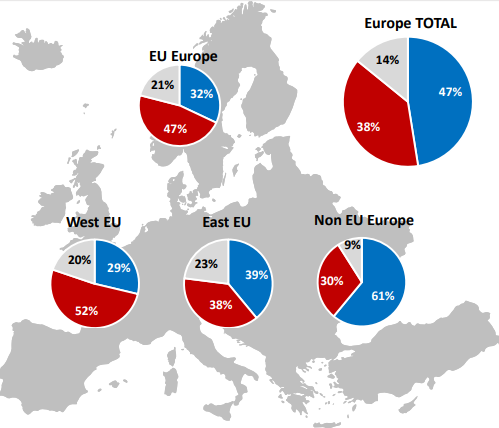
The inflation of asset prices driven by extensive government debt, immigration, and low interest rates (from a historic perspective, interest rates are still unusually low). This prices the young generation out of the property market, making them less likely to marry and have children.
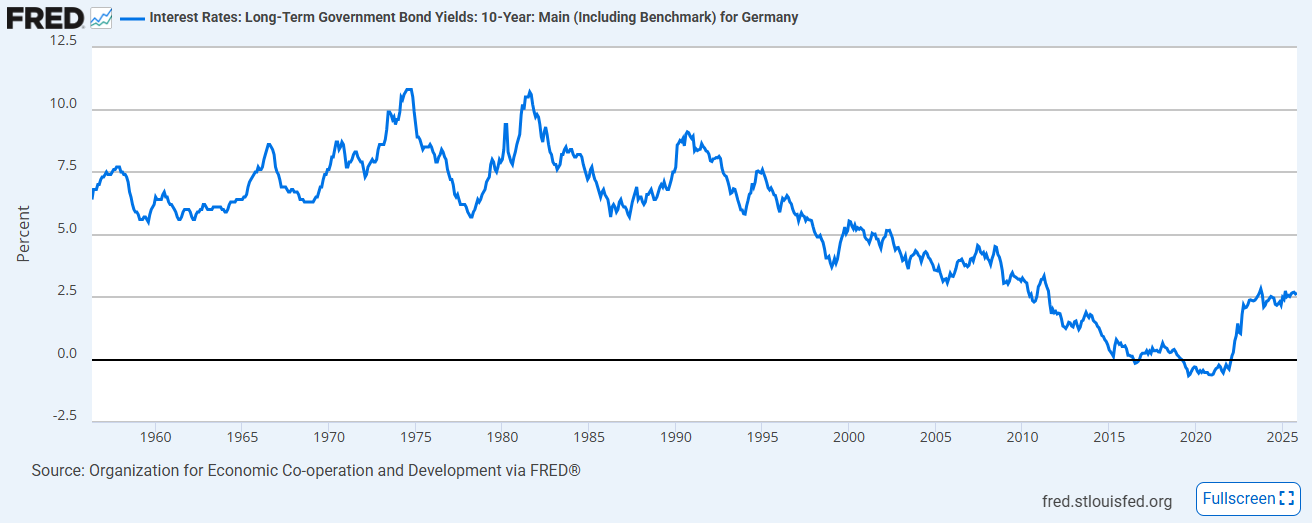
German interest rates from 1956 DEI policies that work against young white men, holding back their careers and sometimes even preventing them from starting a career. Even the Royal Air Force in Britain was complaining that too many of its recruits were white. In a nation where 80% of the population is white, and which is historically and ethnically white, this is madness.
Extreme levels of immigration, meaning that lower paying starter jobs that would have normally gone to young white men, taught them responsibility, and helped them build their careers, are now going to migrants. The path to career development, and, therefore, to gaining value in the eyes of women, has been unfairly closed.
The spread of DEI ideology throughout the education system, government, and media, which constantly demonises white men and their history. This reached such epidemic proportions that it was normal for Conservatives in Britain to complain about institutions being “white, male, and stale”. Why would the male and stale whites fight for an ideology that demonises them?
The imbalanced relationship between men and women, including easy divorce laws that favour women, unrealistic expectations by women, women’s growing earning potential in corporate roles that increasingly discriminate against white men, and stagnant wages in roles that remain male dominated. This reduces the men’s prospects for relationships. Men who have no families behind them, or even the prospect of building families, them have no reason to fight the enemy in front of them.
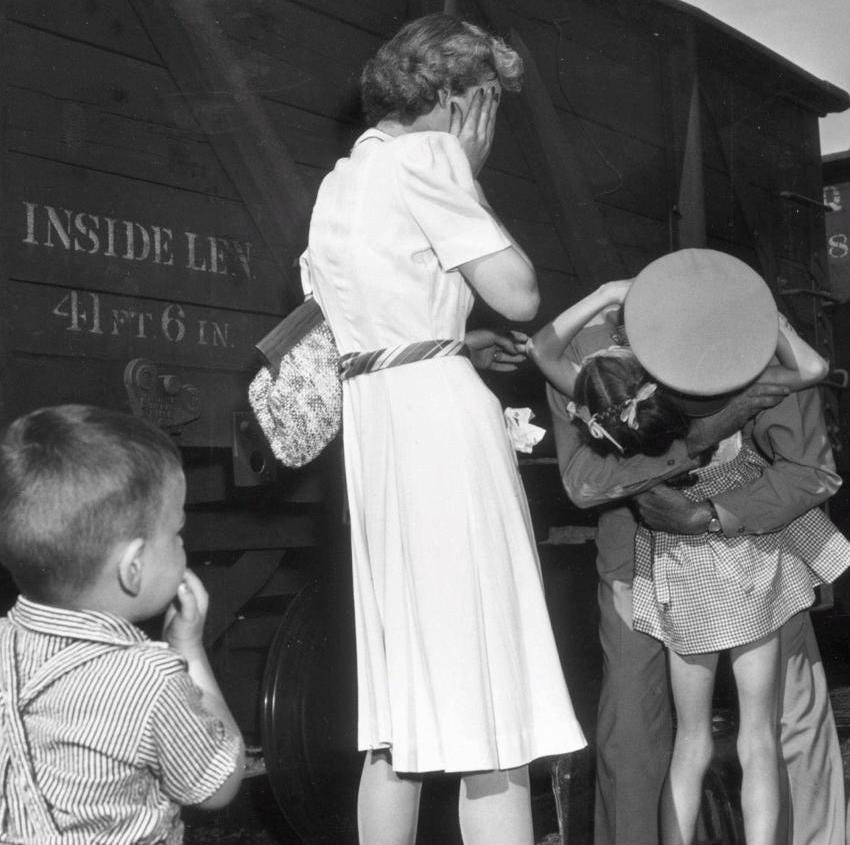
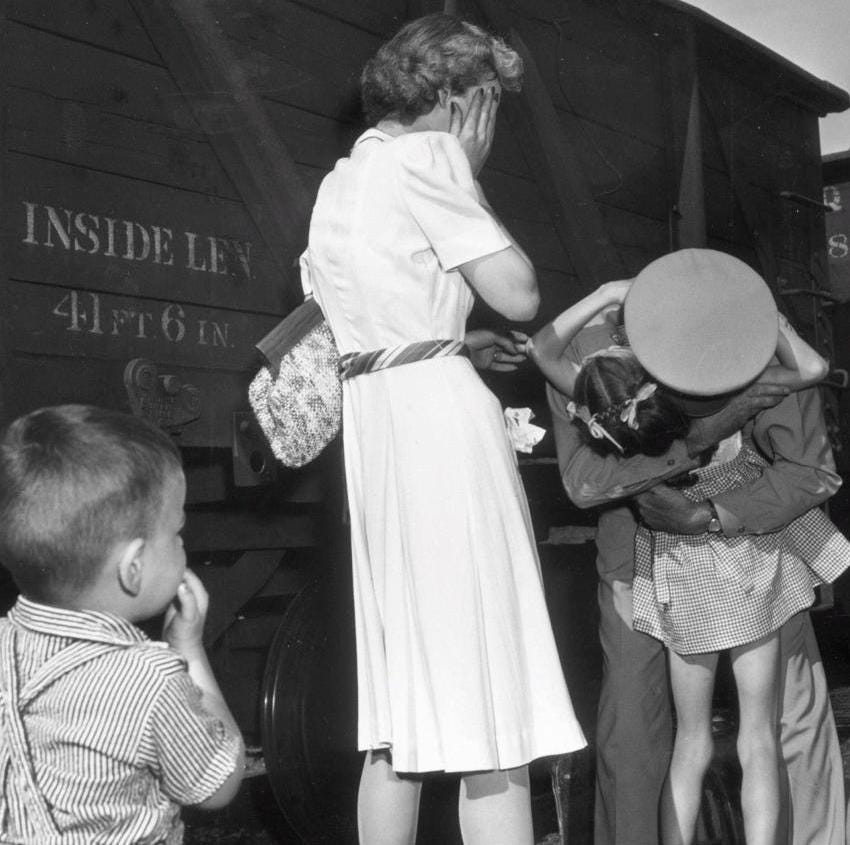
The moment every soldier dreams of: returning to a faithful wife and loving children. Photo by Earle Bunker - Omaha World-Herald, 1943. A moral framework from the previous generation that still believes that hard work and meritocracy are the paths to success, when these avenues have been gutted by immigration and DEI. This is often paired with enthusiasm by the older generation to spend as much of their wealth as they can before they die, while they still receive generous pensions. What in that system motivates white men?
Good men fight not out of hatred of the enemy in front of them, but out of love for what is behind them. Love, by its very nature, requires reciprocity. A society that does not love its young men will get no love from them, and therefore cannot motivate them to fight. This system simply cannot motivate young European men to fight an enemy like Russia, which is far away, when their own societies renounce them, and face an existential threat from migrants who are already there.
The constant risk of terrorism
And the Hannukah Bondi massacre confirms this: the threat from jihadi Islam is constant, it is evident on the streets not just of Australia, but also all of the West. Germany has so far foiled two attacks in the last week, planned by migrants targeting Christmas markets, while Paris has cancelled some of its New Year celebrations out of security concerns. In Britain, all Christmas events are behind held behind what the right calls “diversity bollards”, out of fear of jihadi car ramming attacks. Across Western Europe, Christmas markets now require an armed police presence.
Contrast this with World War I, when ceasefires spontaneously sprung up across the frontline in 1914. Can this system, which fails to protect Jews’ and Christians’ holiest celebrations, generate the same heroism and sacrifices seen in that war? Absolutely not.
The elites’ problem
Europe’s sabre rattling is coming at a time when the political leadership has never been more unpopular. Every single terrorist attack, every single crime by a migrant, delegitimises them further.
White men in Europe feel dispossessed, and they will not fight for the authors of their misery. Christian European societies that cannot celebrate Christmas cannot motivate their men to fight overseas, especially when the ruling classes won’t even let them fight for their homelands that are being overrun by migrants and crime.
Simply, white men, who are the backbone, body and soul of any European military, have no reason to fight for European elites. And for the elites to address their concerns, they would have to abandon the liberal ideology that legitimises them, and with it, their stranglehold on power.
