
The Middle East will burn
Ceasefires will probably not be stable, as the war continues to escalate indefinitely.
Commercial topics: GCC debts, aviation, and infrastructure, including energy. Physical risks to aviation and energy assets. The position of Turkey, Egypt, and Pakistan. Israel entering the war.
Even if the Americans and Iranians reach another ceasefire, there is no reason to expect it to hold. The only thing that would signal a true end to the war is an American withdrawal from the region, including, at the very least, the removal of aircraft carriers and most refuelling aircraft.
Military Update
Reporting by mainstream media, based on satellite imagery and intelligence briefings to journalists, suggests that:
Iran is able to quickly repair sites that are bombed, especially road infrastructure and missile bases’ entrances.
The Americans are unable to stop Iran’s underground missile cities from firing despite repeated strikes.
Iran is attempting to reduce the USA’s ability to conduct strikes by attacking American bases in the region. The Iranians cannot stop the USA conducting strikes, but they can reduce the rate of strikes.
The USA is either running low on ammunition, or is constrained in the number of strikes it can launch due to Iranian attacks on its bases, or is still holding back in the hope of an agreement, despite its rhetoric to the contrary. The latter, if true, would suggest that the USA is still deterred by Iran’s retaliation ability.
The Iranians are signalling their ability to paralyse infrastructure in the Gulf and make it uninhabitable by attacking power and water infrastructure in Kuwait.
There is no sign that the Americans can stop Iran from attacking shipping in Hormuz, even if they can occasionally get some tankers out.
The Houthis’ decision to join the war serves to overstretch the Americans further, allowing the Houthi to last longer than the 51 day 2025 campaign, which ended with a US-Houthi ceasefire that excluded Israel.
Open source reporting suggests that the Israelis are likely to enter the war soon and significantly escalate it, while Iran considers a pre-emptive strike against Israel.
The Americans will be under increasing pressure to commit ground troops to capture islands against Hormuz. This will not succeed, as the Iranians will able to attack shipping throughout the Persian Gulf and the Gulf of Oman, and as they will certainly impose significant casualties on the USA.
Irreconcilable
The red lines of the two sides are impossible to reconcile.
The Americans cannot tolerate Iran controlling Hormuz, and therefore gaining control over 20% of global oil exports. The Iranians cannot allow Hormuz to open normally, as this would cost them their leverage, and allow the Americans to regroup , refill energy stockpiles, and relaunch the war. Moreover, for the Americans, walking away without a deal is not an option: after America’s attacks on Iran, the Iranians now need nuclear deterrence more than ever, and it is obvious that their nuclear programme was NOT obliterated. Additionally, Iran has no choice but to prove its dominance over Gulf states by controlling Hormuz, and pressure them to remove American bases - otherwise, the Americans would be able to return and launch another, bigger war in the future. The conflict is existential for Iran, and for American regional relevance and global power.
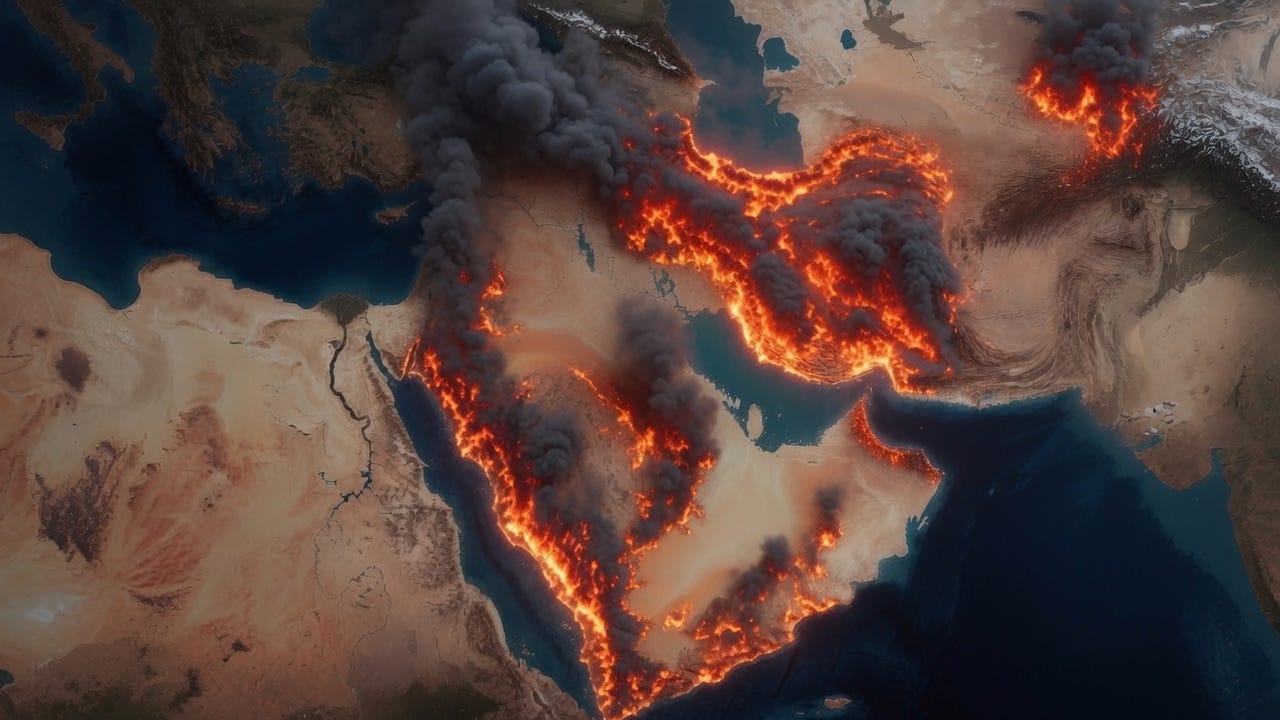
Therefore, our view is that the infrastructure, shipping and energy wars will escalate, and likely expand to an aviation war, with strikes on airports rather than on civilian planes, as Iran attempts to besiege the Gulf states to the extent that they are forced to ask the Americans to leave.
The Houthi Angle
The closure of Bab al-Mandab is similarly difficult to resolve. In theory, the Yemenis need Saudi aid, they need to return to a ceasefire and avoid a major humanitarian crisis. On the other hand, they see the Saudis preparing to defeat them if Iran is defeated. Conversely, the Saudis realise that if Iran gains dominance over Hormuz, it will immediately move to consolidate over Yemen. Now that the war has started, neither side has a way out, even if tactical reasons force temporary ceasefires. And since the Americans are committed to defeating Iran, the Saudis need to commit alongside them and crush the Houthi or at the very least severely constrain them. Similarly, the Houthi need to double down on backing Iran to ensure their own survival. They know that, without Iran, the Saudis and their allies would probably defeat them.
Security vs Economics
This war is increasingly taking an existential aspect: for the survival of the Houthi, for the survival of the Islamic Revolution regime, for Saudi Arabia’s future ambitions under Crown Prince Mohammad bin Salman (MBS), and for America’s role in the region. It is undoubtedly true that attacks on Iranian infrastructure, and restrictions on their oil exports, are a threat to the regime. However, rather than driving them towards a compromise, this is likely to make the competing sides to double down at least until they are convinced of the impossibility of victory, which will not happen soon. In this dynamic, escalation is the logical option for political survival, regardless of the economic consequences.
Similarly, the Americans are unlikely to soon surrender their influence over the Gulf to Iran, without a major breakthrough in the talks that renders Iran into a security partner of the USA. This is not on the table right now. Higher oil prices will increase pressure on the USA to seek ceasefires, but, it is unlikely that the Iranians will concede to that without a full agreement and a significant withdrawal of American forces. That would be a major victory for Iran, which the Americans will not be eager to concede.
The Sunni Powers
One question our readers have asked is, do the Sunni powers in the region choose to back the Gulf states.
