
Commercial Summary: an insurgency in Venezuela is likely if the regime falls, regardless of whether Maduro agrees to leave. If the Venezuelans fight, risks to shipping and aviation would be significant, including to offshore energy assets. Control of Venezuela’s energy infrastructure would allow the Americans far more freedom of action globally, and would be a game changer for energy markets, especially for the physical security of energy assets. Any regime change in Venezuela would be a game changer for Latin America in general, and for WASP-Latino relations within America.
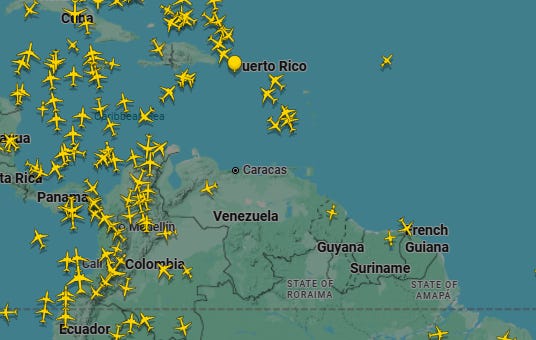
President Trump announced on 29 November that Venezuela’s airspace should be considered closed. On 21 November, the Federal Aviation Authority had issued a Notice to Airmen (NOTAM) covering the Maiquetía Flight Information Region (SVZM FIR), which includes the airspace over Venezuela and up to 350 miles from its coasts. The NOTAM will be in effect until 19 February 2026.
Preparations for War
We are unsure whether the Americans are engaged in a pressure campaign to create the impression that they are ready for war, and therefore to gain leverage and pressure Venezuelan President Nicolas Maduro to leave, or if they are genuinely planning a large military attack.
The indicators for military action include:
Leaks to media of talks between Venezuelan President Nicolas Maduro and the USA over the terms of his exit, intended to fragment the regime.
Extensive naval presence that pave the way for a naval blockade on Venezuela, with the USA expanding its military bases in Puerto Rico and elsewhere to prepare for a more permanent, more muscular presence in the Caribbean.
The designation of the Cartel de los Soles as a terrorist organisation, building a legal case to kill senior Venezuelan officials.
The granting of the Nobel Peace Prize to Maria Corina Merchado, one of the leaders of the Venezuelan opposition - who has now been designated by the media as the leader of the opposition. The Americans typically “create”, more accurately, build up, local opposition leaders into a global brand ahead of handing them power of a targeted country.

Meanwhile, the Venezuelan government seems to be preparing to fight an insurgency against any American occupation or successor regime.
America’s logic
There a key intersection between America’s geopolitical priorities and domestic priorities.
Mexico, Brazil and Colombia, have all come out in opposition to any American intervention in Venezuela. For one thing, all three governments are run by extreme leftists - in Mexico, President Sheinbaum depends on cartel money for economic stability, with up to 2.8% of GDP coming from laundered drug funds and perhaps 175,000 people working for the cartels and the industries that they now control. Mexico under MORENA lacks the political will to follow in the footsteps of El Salvador’s President Nayyib Bukele, who had the revolutionary idea of locking up anyone associated with criminal gangs in high security prisons.
Venezuela, Brazil, Colombia and Mexico have all decided to align much of their governments with criminal gangs, as a cheaper and easier alternative to crushing those gangs. The latter would require competent economic, political, and social policies even before competent security policies. The former, based on neglect of criminal groups, and on extensive corruption, is much easier.
