
Why the ceasefire is fraying
Does the Middle East go into permanent war or is this just a negotiating tactic?
Commercial topics: The drivers of the ceasefire slowly breaking down, the most likely outcomes, the possibility of endless war, why talk of pipelines replacing Hormuz is misguided, and the impact of this escalation on global markets.
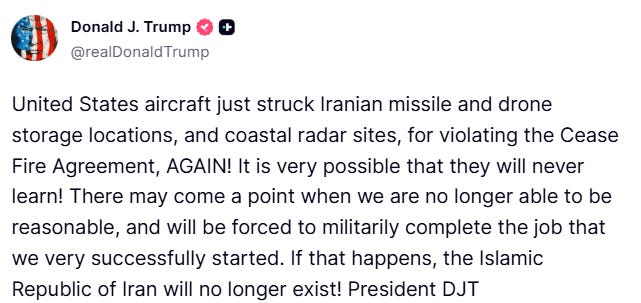
The Iranians have resumed attacking ships in Hormuz, as we had said last week.

This led to two separate attacks on international shipping attempting to bypass the Iranian transport corridor and going through the Omani corridor. The Americans have retaliated to both, leading to Iranian retaliation in turn. As is typical, Trump has resumed his threats to obliterate Iran.
The drivers of this breakdown in the ceasefire are five:
Lebanon: Israel and the Lebanese government signed an agreement that would, in theory, at an undetermined point, lead to an Israeli withdrawal from Lebanese territories in exchange for Lebanon’s government disarming Hezbollah. This deserves a brief digression:
Israel will not withdraw from Lebanese territories except through military means - this has been the example of the precedent set since the Yom Kippur War of 1973. Rather, the stage is being set for a major conflict between the Lebanese government, the Sunnis, and some Lebanese Christian factions against the Shi’a.
Iran viewed Lebanon as a test. With the agreement paving the way for more conflict against the Shi’a in Lebanon, Iran views this as a sign that the Americans and Israelis still want to escalate.
Hormuz: for the Iranians, any attempt to bypass them via Hormuz paves the way for them having to relinquish control of the Strait, which as become a core national security priority, as it will fund Iranian reconstruction and permit Iran to become the main player in global energy markets. By controlling Hormuz, Iran controls the OPEC quotas of Gulf Arab states and profits from their oil exports by charging fees. For the Americans, this is an unacceptable state of affairs.
Iraq: as of this morning, the new Iraqi cabinet is engaging in a major crackdown on political figures associated with Iran and/or implicated in corruption. For the Iranians, this may well appear as an attempt to cut them off financially from Iraq and to push Iraq closer to America, Turkey, and Saudi Arabia. Iraq and the Persian Gulf are core national security interests for Iran.
Economics: the Iranians believe that they have the upper hand.
