
Since the failure of the second Ottoman siege of Vienna, the Muslim world has been on the decline, gradually losing ground. This trend peaked with the Sykes Picot Agreement, in which the Holy Land was handed over to the future Jewish state of Israel, and the fall of the Ottoman Empire. For the first time, there was no central religious authority governing Muslims. To the Muslims, the humiliation of the loss of Jerusalem and Palestine was intolerable. This kicked off a major wave of revolts by nationalist, left wing, more or less secular, military officers - Gaddafi, Nasser, Assad, Abdul Karim Qassem, and others - who wanted to modernise their countries and better prepare them to confront the challenge from the West. One by one, these nationalist, secular(ish) dictatorships were felled or co-opted by the USA.
Now, the vacuum that this created has unleashed two powers: Israel and Turkey. However, Turkey is starved for foreign currency and lacks a nuclear umbrella. Therefore, it is aligning more closely with Saudi Arabia and Pakistan, who are both hostile to Israel.
The consequences of unrestraint
Initially, when the Syrian regime of Bashar al-Assad fell, we assumed that Saudi Arabia would work against Turkey in partnership with Iran. However, several things have happened that make us, and probably the Saudis, rethink this:
Israel bombarded Syria’s military after Assad’s fall, and continues to occupy Syrian territory and trying to partition Syria. This, along with the war crimes in the Gaza War, showed that the USA would not rein in Israel.
Israel bombed Qatar in September 2025, terrifying Saudi Arabia and driving it to sign a defence agreement with Pakistan that extended Pakistan’s nuclear umbrella to Saudi Arabia. The strikes showed that American security guarantees did not mean much when it came to Israel - despite Qatar, along with the UAE and Saudi Arabia, agreeing to provide enormous funding to the USA.

In December 2025, the UAE’s proxies tried to take over all of southern Yemen, neutralising Saudi influence. Crucially, the UAE is Israel’s main Arab partner. For the Saudis, this seemed like an Israeli-Emirati plot to surround them. Saudi Arabia wants to have access to Yemen’s south, as a possible route for oil exports in the future and to prevent it from being enveloped. It does not want rival regional players in Yemen, even though it has been forced to tolerate Iran’s influence over the Houthi.
On 29 December 2025, Israel recognised Somaliland as an independent state. This created the perception for the Saudis that the Israelis were trying to control access to the Red Sea, threatening Saudi shipping.
The USA almost launched strikes on Iran in January 2026, and continues a massive military build-up to attempt a potentially prolonged regime change operation. This is opposed by Turkey and Saudi Arabia, as it can trigger regional instability, including in Iraq. Critically, there is no reason for these strikes except as part of an American pro-Israel policy. Geopolitically, Iran is a natural ally to the West, given that it is surrounded by Sunni powers that, in most times, are hostile to it. The only difference now is that a weakened but stable Iran suits Saudi Arabia and Pakistan, and, to some extent, Turkey.
The Saudi perspective
The Saudis especially do not want American strikes on Iran. They were among the most prescient critics of the 2003 Iraq War, which they knew would unleash Iran on the Middle East. They fear that a war with Iran would similarly unleash Turkey, allowing it to dramatically improve its position in Iraq, and, in extremis, perhaps even reach Basra. This would place the Gulf at Turkey’s mercy, and largely recreate the Ottoman Empire. Even without the fear of Turkey, opening up Iran to Western investment may eventually lead to dramatically lower oil prices. In 1978, Iran was producing 6 million barrels per day, compared to 3.5 million barrels per day in 2025. With additional investments, Iran could realistically reach that figure in a few years, and perhaps exceed it, threatening Saudi Arabia’s main geopolitical power: its role as the swing oil producer that everyone needs to balance oil markets.
Turkey: risks vs opportunities
The Turks, for their part, are concerned about strikes on Iran for several reasons. First, they do not want a massive wave of refugees that could turn the public against the government. Second, they do not want the possibility of civil war in Iran, which could reinvigorate a Kurdish insurgency in Iraq and Turkey. Third, they do not want this precedent of America removing regimes that oppose Israel to keep on being repeated in the Middle East - the Turks themselves could be next.
On the other hand, the collapse of Iran would enormously destabilise Iraq, and may lead to Shi’a - Shi’a infighting. This would pave the way for a Turkish takeover of northern Iraq, fulfilling the Turkish ambition of capturing Kirkuk. Again, it is worth recalling that Ottoman control extended all the way to Basra and Kuwait. The weakening of national states like Iraq and Syria suits the Turks. However, why risk chaos when Turkey, in partnership with Qatar and perhaps Saudi Arabia, can dominate Iraq economically? This seems to be the preferred Turkish policy.
Pakistan
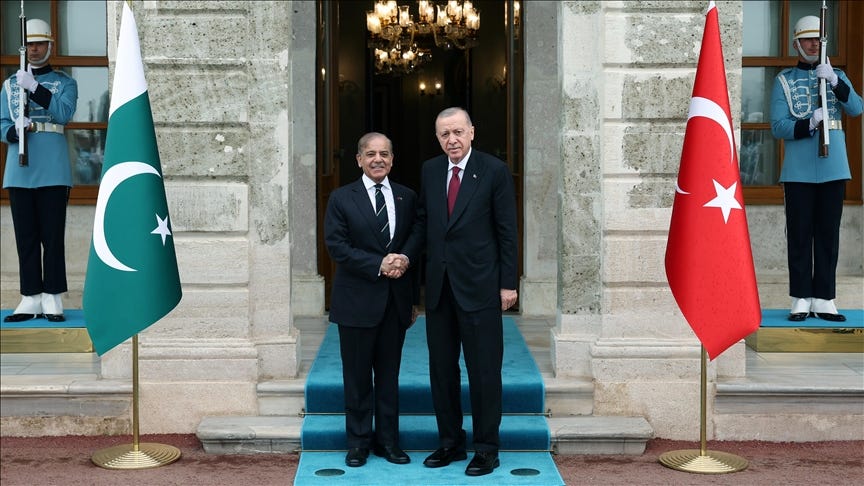
For the Pakistanis, Islamic unity is a useful rhetorical tool - so long as, in practice, it does not threaten the military’s grip on power. Furthermore, strategically, Pakistan needs the military partnership it has established with Turkey over the past decades, and the Saudi funding and investments that permit it to maintain its economy. Therefore, Pakistan rushed into an alliance with Saudi Arabia, extending their nuclear umbrella to Islam’s holiest sites. Pakistan almost certainly sees opportunities to upgrade its cooperation with Turkey in the nuclear front. Moreover, the Pakistani population is deeply hostile to Israel, and wants greater Muslim unity. Aligning with these countries plays very well domestically, and suits Pakistan’s geopolitical interests. The more Pakistan is aligned with the Muslim world, the greater the threat it poses to India, and the greater its value to China.
A new dynamic
Although Turkey, Pakistan, and Saudi Arabia often have diverging interests in some arenas - especially Turkey and Saudi Arabia - a different dynamic is emerging. The rise of China and America’s reckless, blind support for Israel are driving these three countries into a new arrangement: between them, they can resolve their interests in a satisfactory manner, while sidelining smaller, destabilising players like the UAE, Israel, and, in some cases, Egypt. The Turks do not have the power to conquer the region, and their economy, like Pakistan’s, is often starved for foreign currency. The Saudis have the foreign currency, but, they are in complete dependence on the USA, which has proven itself to be an unreliable and unpredictable partner, beholden to Israel. Pakistan, for its part, provides nuclear cover, and can transfer nuclear weapons to both.
By collaborating with one another and with China, these three Muslim countries can have their way in their regions and exclude the smaller players. Most importantly, they can contain the UAE, the USA and Israel, and begin to reverse the consecutive defeats of the Muslim world. Islam is surging again, and its three most geopolitically consequential states are coordinating its rise. The more they jointly assert their power, the greater their influence.

