
Thinking the unthinkable
Is Iran is seizing the moment to build a thousand year Revolution? And does that lead to a much larger global war?
We had thought that the prospect of Iran facing Turkey, Pakistan, and Saudi Arabia would act to deter them. So far, it seems that we were wrong.

Rather, it appears that the Iranians saw the Sunni threat, and may have decided to seize as much as they can before it materialised, focussing primarily on the Arabian Peninsula.
In our piece The War for the Heart of the Muslim World, we had explained that there was a three way war for the domination of the Middle East, and that Saudi Arabia, the third contender alongside Iran and Turkey, was getting battered.
The logic of Iranian escalation
The Iranians see this. They see the Sunni world rallying against them. This leaves them with two choices.
Attempt to find a new security architecture, where the trilateral alliance recognises Iran’s interests in Bahrain (60%-70% Shi’a), Kuwait (30% Shi’a, and key staging ground against Iran and Iraq), Iraq (60% Shi’a), Yemen (30% Zaidi Shi’a), and Lebanon (30% Shi’a), while also accepting its domination of Hormuz, Bab al-Mandab, and the Persian Gulf.
Escalate, and take what they can now, given that Iran has major advantages in that it has capable proxy armies in Yemen and Iraq. The alternative would allow the Sunni powers to improve their position at its expense.
The first option is unrealistic. Iran knows that the Sunni powers will not indefinitely tolerate it having such an advantageous position. The very existence of countries like Lebanon, Iraq, Yemen, and the Persian Gulf states, and their recognition under the post-war order as sovereign states, guarantees that these countries will always be facing internal strife. From a realist perspective, this recognition confirms in law what is in reality just fiction - these are not sovereign nations in the Westphalian sense, but hostile communities stuck in a prison cell formed by the international order. Therefore, this strife will continue, and will be exploited by the now united Sunni powers against Iran - Iran’s main strength against the Muslims in Iraq, Syria, Lebanon, and Yemen was their lack of unity. Meaning that the Iranians have no time to waste, as their advantage against the three combined economies of Turkey, Pakistan and Saudi Arabia, and their political cooperation, is likely only temporary.
Therefore, the Iranians must escalate in contested areas, press their advantage quickly, and prevent the Gulf from taking advantage of increased oil demand to fix their own budgets, and back Turkey and Pakistan.

A web of alliances
However, proxy wars over contested regions can turn into direct conflicts. This is how the Iran-US War began, as a conflict between Israel and Hamas and Hezbollah that drew in the principals.
Moreover, the alliance structure currently in place is rather dangerous.
The Israelis are allied with the UAE, Cyprus, Greece, and India, and to a lesser extent Morocco. The Turks are now allied with the Pakistanis and Saudis. They can probably also rely on the Algerians to support them - Morocco’s neighbours and nemeses. And Iran has a regional alliance network that includes proxy forces Yemen, Iraq, and Lebanon. Iran obviously has ambitions on Kuwait, Bahrain, Qatar, and the UAE, and even on Saudi Arabia’s historically Shi’a and oil-rich Eastern Province. Further complicating the picture is Pakistan’s military dependence on China, and Turkey’s ambition for a Middle Corridor linking it to Azerbaijan, Central Asia, and China. The Russians are pre-occupied with Ukraine, but they most certainly do not want Chinese-Turkish cooperation to weaken them in Central Asia and the Caucasus. Rather, the Russians have been looking for an alliance with India and Iran, in part as a counterbalance to China and the USA. Which is why Russia kept selling India weapons during and after the Cold War.
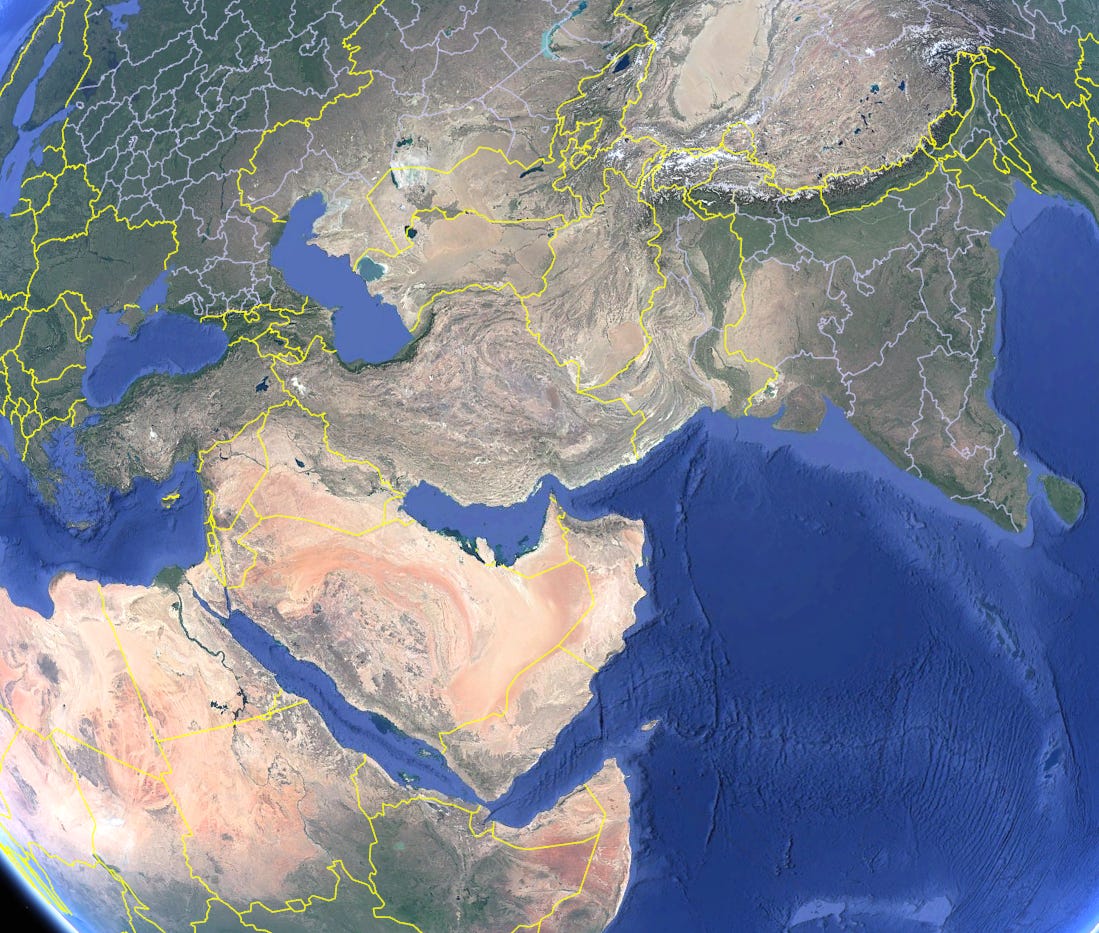
Critically, if the Iranians thought they were under threat from Sunni powers, they would need to work with India against Pakistan, and with Israel against Turkey and Saudi Arabia. After all, India committed to invest in Iran’s Chabahar Port in order to check the China Pakistan Economic Corridor, which terminates at Gwadar Port, less than 200km from Chabahar. India was hoping to connect to Russia and Afghanistan to counter Pakistan. That investment in Chabahar has now been paused, but the rise in Sunni cooperation may reactivate it.

This alliance and counter-alliance framework is reminiscent of the period before World War I. These things tend to escalate slowly, then suddenly, and very unpredictably.
What if the current Iran War is just the slowly part?
The Americans, by launching a war with Iran, have pushed things into chaos. At a time when they have also largely successfully - at least for now - consolidated over Latin America, ensuring their ability to eventually recover from the impact of the Iran War much faster than Europe, and, they hope, China. The main American interest is in this chaos escalating, pushing the various Middle Powers of the Middle East and Asia into conflict. Chaos abroad, stability at home, is how a declining empire hopes to recover its place.
